


Find us on
Your best candidate is probably hiding in plain sight.

Youssef A. Mallouk
Market Research

The talent you're looking for might already be in your network. The real challenge? Knowing where to find it.
Somewhere in your organization, there's a recruiter who knows exactly the right person for a new opportunity.
The problem is that nobody else knows where to find them. Maybe their CV is sitting in an old email thread. Their availability was updated over WhatsApp. Their latest experience? Still waiting to be added to a profile. And the recruiter who knows them best happens to be on holiday.
Sound familiar?
It's one of those everyday problems in recruitment that rarely gets discussed. Not because it isn't important, but because everyone has become used to working around it.
The talent is there. The visibility isn't.
Recruitment teams spend a considerable amount of time searching for professionals. But how much time is spent searching for professionals they already know?
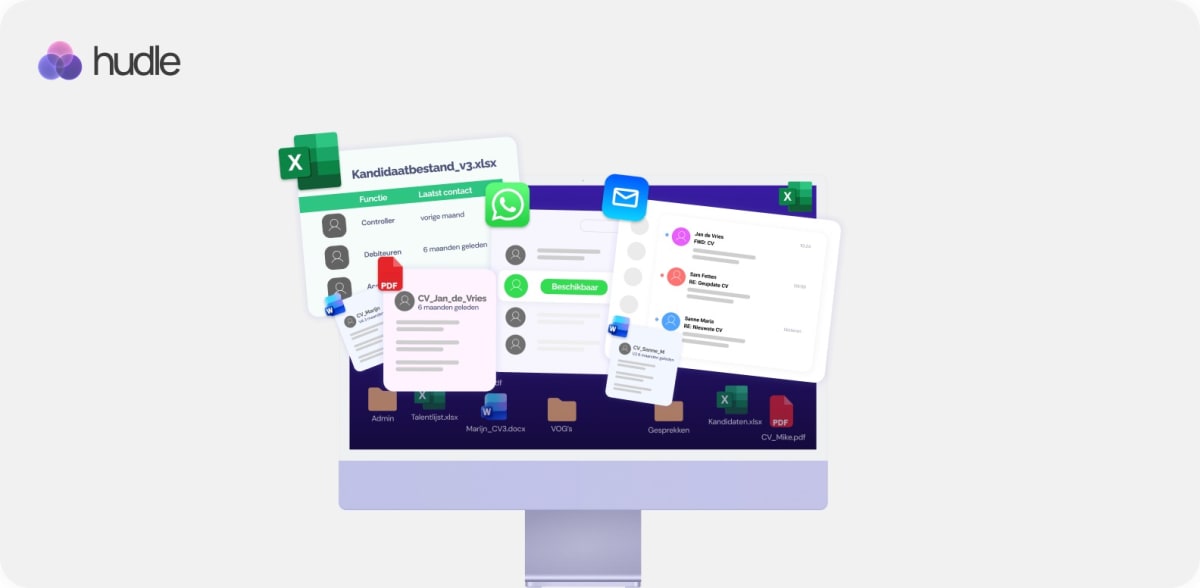
Across staffing and secondment organizations, valuable candidate information often lives in different places. A CRM contains one version of a profile. An ATS contains another. A spreadsheet tracks availability. Conversations about skills, preferences and opportunities happen somewhere else entirely.
Each system might serve its own purpose. The problem starts when people have to piece everything together to make a decision.
A professional may be perfectly suited to a new assignment but never make it onto the shortlist. Not because they lack experience, but because their information wasn't available at the right moment.
You can't match talent you can't see.
Recruitment shouldn't depend on someone's memory.
Think about what happens when a new client request arrives. Your team needs answers.
Who has the required skills? Who becomes available soon? Is the CV up to date? Has this person already been introduced to another client? What was the feedback?
These aren't complicated questions. But answering them becomes unnecessarily difficult when information is scattered across tools and conversations.
Suddenly, finding the right professional requires asking three colleagues, checking multiple systems and requesting another CV update. By the time everything comes together, valuable time has passed. And in a competitive recruitment market, time matters.
A talent pool should be more than a list of names.
Having hundreds or thousands of professionals in your database doesn't automatically mean your team can make effective use of them. A valuable talent pool needs more than contact information.
It needs current skills, relevant experience, availability, professional profiles and visibility into previous opportunities.
More importantly, that information needs to be accessible to the people who actually work with it. When recruiters and Resource Managers share a clear picture of their talent pool, they can spend less time searching and more time making meaningful connections.
Instead of asking, "Do we know anyone for this role?" They can start asking, "Who should we present first?"
That's a very different conversation.
Better visibility creates better opportunities.
You don't always need another sourcing campaign or a larger database. Sometimes the biggest opportunity is improving how your organization works with the talent it already knows.
Keeping professional information current. Making availability visible. Connecting skills to opportunities. Bringing feedback back into the workflow.
Individually, these improvements might seem small. Together, they can change how quickly and confidently a team responds to new requests. Because great talent shouldn't disappear simply because its information lives in the wrong place.
The next great placement might already be in your talent pool.
You just need to find it.